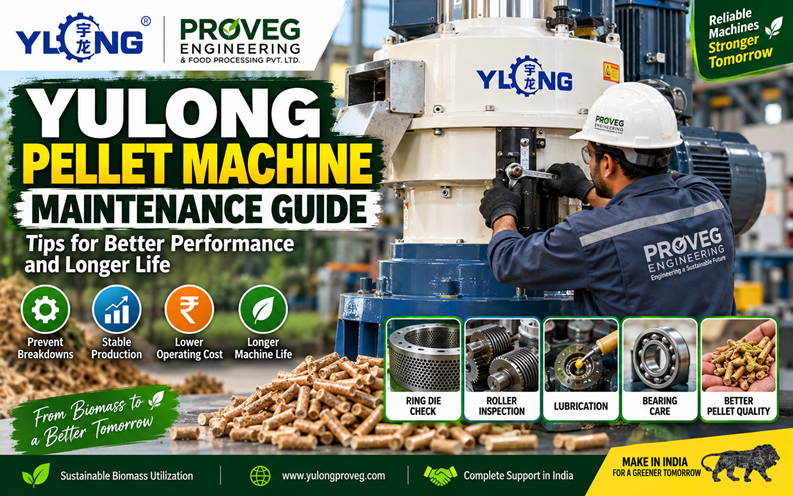
A biomass pellet machine works continuously under heavy load. It handles pressure, heat, dust, moisture and different types of biomass every day. Because of this, buying a good pellet machine is only one part of the job. Regular maintenance is equally important if you want stable production, good pellet quality and controlled operating costs.
For industries using a Yulong Pellet Machine, a simple and regular maintenance routine can help identify problems before they turn into major breakdowns. Ring die condition, rollers, bearings, lubrication, feeding, electrical components and raw material preparation all have an effect on the performance of the pelletizing system.
Yulong Proveg provides Yulong biomass pellet machinery and plant solutions in India, including pellet mills, hammer mills, conveyors and other equipment used in complete biomass pellet production lines. Technical support and spare parts are also important parts of keeping a pellet plant running smoothly.
Why Yulong Pellet Machine Maintenance Matters
A pellet machine is one of the most important sections of a biomass pellet plant. If the pellet machine is not maintained properly, small issues can gradually become production problems.
For example, worn rollers or a damaged ring die can affect pellet quality. Incorrect feeding can increase machine load. Poor lubrication can increase wear in moving components. Foreign materials such as metal can damage important parts.
Regular maintenance helps you:
- Maintain consistent pellet production
- Reduce unexpected machine downtime
- Monitor ring die and roller wear
- Maintain better pellet quality
- Identify abnormal vibration or noise early
- Control unnecessary power consumption
- Plan spare parts replacement before a major breakdown
- Keep the pellet plant running more reliably
1. Check the Ring Die Regularly
The ring die is one of the most important working components of a pellet machine. Biomass is compressed through the die holes to form pellets, so the condition of the die directly affects pellet production.
The ring die should be inspected regularly for:
- Uneven wear
- Blocked die holes
- Cracks or physical damage
- Abnormal pellet size
- Reduced production
- Increasing power consumption
- Frequent pellet blockages
If the die holes become blocked, production can become unstable. Cleaning should be carried out using the correct procedure rather than using methods that can damage the die surface.
2. Inspect the Pressure Rollers
The rollers work together with the ring die to compress the prepared biomass. Since they operate under high pressure, roller condition is important for stable pellet production.
Check the roller surface regularly and look for uneven wear, damage or abnormal marks.
If the rollers are worn unevenly, the machine may not perform consistently across the complete die surface. Roller adjustment should therefore be carried out according to the machine design and manufacturer recommendations.
3. Do Not Ignore Lubrication
Lubrication is one of the easiest maintenance activities to overlook in a busy pellet plant.
Bearings, transmission components and other moving parts need proper lubrication according to the machine manual and operating conditions.
Too little lubrication can increase friction and wear. Using an incorrect lubricant or applying excessive lubricant can also create problems.
A practical maintenance routine should include:
- Checking lubrication points
- Checking for lubricant leakage
- Using the recommended lubricant
- Following the manufacturer specified maintenance procedure
- Recording lubrication work for future reference
For a continuously operating pellet plant, maintenance records are particularly useful because they help the operator understand when components were serviced or replaced.
4. Check Bearings and Moving Components
Bearings work under demanding conditions inside a biomass pellet plant. Dust, heat, vibration and continuous operation can affect bearing performance.
During inspection, pay attention to unusual:
- Noise
- Vibration
- Temperature
- Movement
- Lubricant leakage
If a bearing starts making an unusual sound or showing abnormal temperature, it should not simply be ignored. Early inspection can prevent a small bearing problem from developing into a larger mechanical failure.
5. Keep the Feeding System Stable
Many pellet machine problems actually start before the material reaches the pelletizer.
If the feeding system supplies material unevenly, the pellet machine can experience changing load conditions. Sudden overfeeding can increase machine load, while insufficient feeding can reduce production.
The feeding system should therefore be checked for:
- Material bridging
- Blockage
- Uneven feeding
- Foreign material
- Moisture-related sticking
- Conveyor or feeder problems
A stable feeding system is especially important when processing agricultural residues such as paddy straw, cotton stalk, soybean husk, maize residues or other biomass materials.
6. Raw Material Moisture Has a Direct Effect on Pelletizing
One of the biggest mistakes in biomass pellet production is assuming that the pellet machine alone controls pellet quality.
In reality, raw material preparation has a major influence on the complete process.
Moisture should be checked regularly rather than estimated only by looking at the material.
If biomass is too wet, pelletizing can become difficult and the material may not behave properly inside the machine. If the material is excessively dry, the pellet formation process can also be affected.
This is why moisture control is an important part of pellet machine maintenance and plant operation.
7. Make Sure the Biomass Particle Size Is Suitable
Before biomass reaches the pellet machine, it may need shredding, chipping, cutting or hammer milling depending on the raw material.
Large or irregular particles can affect feeding and pellet formation. Properly prepared material generally provides more consistent conditions for pelletizing.
Depending on the raw material and plant design, the complete processing line may include:
- Wood Chipper
- Straw Cutter
- Double Roller Shredder
- Biomass Hammer Mill
- Rotary Dryer
- Pellet Machine
- Pellet Cooler
- Screener
- Packing Machine
The condition of upstream equipment can have a direct effect on the performance of the pellet machine.
8. Keep Metal and Foreign Materials Away From the Pellet Machine
Biomass often comes from agricultural fields, wood processing facilities or other waste streams. Depending on the source, it can contain stones, metal pieces, wire or other unwanted materials.
These materials can cause serious damage to pelletizing equipment.
A good biomass processing line should therefore have appropriate material inspection and foreign-material protection before the feed reaches critical equipment.
This is particularly important when processing materials such as paddy straw, cotton stalk and other agricultural residues collected from fields.
9. Watch for Changes in Power Consumption
Operators should not look only at tonnes per hour. Power consumption can also provide useful information about machine condition.
If the machine suddenly starts consuming more power than normal under similar operating conditions, investigate the reason.
Possible areas to inspect include:
- Raw material moisture
- Particle size
- Feeding rate
- Ring die condition
- Roller condition
- Mechanical friction
- Bearings
- Machine alignment
Power consumption should always be evaluated against actual production conditions rather than using one fixed number as a universal benchmark.
10. Listen to the Machine
Experienced pellet plant operators often notice a problem simply by hearing a change in machine sound.
A new vibration, unusual knocking sound, sudden increase in noise or change in operating sound should be investigated.
Do not wait until the machine stops completely.
Preventive maintenance is generally easier and less disruptive than emergency maintenance during production.
11. Keep the Pellet Machine Clean
Biomass plants naturally generate dust and small particles. If dust accumulates around motors, electrical panels, bearings and other equipment, it can create operational and safety problems.
Regular cleaning should be part of the daily operating routine.
Pay special attention to:
- Machine surroundings
- Motor area
- Electrical panels
- Feeding area
- Pellet discharge area
- Dust collection system
- Lubrication points
Cleaning should always be performed safely, with the equipment stopped and isolated according to the plant safety procedure.
12. Maintain a Spare Parts Plan
A pellet plant cannot afford long downtime because one wear part was not available when required.
Important spare parts should therefore be planned according to the machine model, operating hours and raw material.
Depending on the machine configuration, commonly required pellet machine spares can include:
- Ring Dies
- Rollers
- Bearings
- Seals
- Fasteners and related components
- Other machine-specific wear parts
Keeping critical spare parts available can significantly simplify maintenance planning.
Practical Yulong Pellet Machine Maintenance Checklist
| Maintenance Area | What to Check |
|---|---|
| Ring Die | Wear, blockage, cracks, die holes and pellet quality |
| Rollers | Surface condition, wear and adjustment |
| Bearings | Noise, vibration, temperature and lubrication |
| Lubrication | Lubrication points, leakage and lubricant condition |
| Feeding System | Uniform feeding, blockage and foreign material |
| Raw Material | Moisture and particle size |
| Motor | Abnormal noise, temperature and electrical condition |
| Electrical Panel | Connections, dust accumulation and abnormal heating |
| Machine Body | Loose bolts, vibration and abnormal movement |
| Spare Parts | Availability of critical wear parts |
Daily, Weekly and Periodic Maintenance
A simple maintenance schedule can make pellet plant operation much easier.
Daily Checks
- Check machine sound and vibration
- Check feeding consistency
- Check pellet quality
- Check for unusual temperature
- Clean dust and biomass accumulation
- Check for visible leakage or loose components
Weekly Checks
- Inspect roller and die condition
- Check bearings and lubrication points
- Inspect bolts and fasteners
- Check feeding and discharge systems
- Inspect electrical connections and panels
Periodic Maintenance
- Detailed inspection of major mechanical components
- Inspection of ring die and rollers
- Bearing inspection
- Gearbox and transmission inspection as applicable
- Electrical system inspection
- Replacement of worn components
- Review of maintenance records
The exact maintenance interval should be based on the Yulong machine model, operating hours, raw material and manufacturer recommendations.
Common Signs That Your Pellet Machine Needs Attention
Sometimes the machine itself gives an early warning that maintenance is required.
Look out for:
- Sudden drop in production
- Change in pellet density or appearance
- Higher power consumption
- Frequent blockage
- Unusual machine noise
- Excessive vibration
- Uneven roller or die wear
- Increasing downtime
- Abnormal bearing temperature
These symptoms do not always indicate the same problem. Raw material moisture, particle size, feeding rate and other plant conditions should also be checked before replacing a machine component.
Maintenance Is More Than Just Repairing the Machine
One thing we have seen repeatedly in biomass projects is that machine maintenance cannot be separated from the rest of the plant.
If the raw material is not prepared properly, even a well-maintained pellet machine may not deliver the expected result. If the dryer is not working correctly, moisture can become a problem. If the hammer mill produces inconsistent material, pelletizing conditions can change.
That is why maintenance should be considered at the complete plant level.
Raw material preparation, drying, size reduction, feeding, pelletizing, cooling, screening and packing all need to work together.
Why Local Service and Spare Parts Support Matter
For a biomass pellet plant, downtime can affect the entire production schedule. This is why technical support and spare parts availability are important when selecting a pellet machine supplier.
For a new project, it is useful to discuss maintenance requirements, recommended spare parts and service support before commissioning the plant rather than after the first breakdown.
Conclusion
A Yulong Pellet Machine is an important part of a biomass pellet production line, but good production does not depend on the pellet machine alone.
Regular inspection of the ring die and rollers, proper lubrication, stable feeding, suitable raw material moisture, correct particle size, clean operating conditions and planned spare parts can all contribute to reliable plant operation.
The best maintenance approach is simple: do not wait for a breakdown. Monitor the machine regularly, record changes in performance and investigate small problems before they become expensive production stoppages.
If you are planning a new biomass pellet plant or already operating a Yulong pellet machine and need help with machine selection, plant configuration, installation, commissioning, maintenance or spare parts, Proveg Engineering can assist with the complete project requirement.
Start Your Biomass Pellet Project with Yulong Proveg
Yulong Proveg – Yulong Biomass Pellet Machinery and Complete Pellet Plant Solutions in India
We support biomass pellet projects from raw material evaluation and machine selection to plant engineering, installation, commissioning and technical support.
Website: www.yulongproveg.com
Proveg Engineering: www.provegengineering.in
Email: info@yulongproveg.com


